Mencius Moldbug, also known as Curtis Yarvin, is probably well-known to everyone reading this. He has been the subject of several news articles, and is widely credited as being a serious “political theorist” with an extensive model of where leftism came from and how to defeat it.
This is part 1 of a series of articles analyzing Moldbug’s thought using new findings that have emerged in the study of leftism and political behavior. How well do Moldbug’s theories hold up in the face of science? Was Moldbug’s epistemological approach valid? Why do false theories remain popular? All of this will be covered over the course of this series. To not miss new installments, make sure you subscribe:
In this article, I will summarize Moldbug’s general theory, and then I will break down his theory of leftism more finely . After that, I will question whether his theory of leftism holds up in the face of scientific scrutiny. In coming articles, I will examine other aspects of his view of politics in the same way.
Curtis Yarvin has two main hypotheses regarding the origins of leftist policy and how to defeat it. The first is the ultra-Calvinist hypothesis. This hypothesis assumes an improbable model of memetic spread and states that leftism ``evolved'' from mainline Protestantism under the selective pressure of separation of Church and State.
In his ``model,'' this separation seems to be merely given, similar to how in Hanania’s model, the law is simply given. He conceives of an environment where a religion is assumed to be a replicating organism, like a virus that spreads through text. The State was resistant to “God” viruses, so Christianity evolved to drop God from their formulas, and thus infected the State as Progressivism.
His second hypothesis is complementary to the first one. It is the Cathedral hypothesis. The ultra-Calvinist hypothesis explains where leftist policy comes from. The Cathedral hypothesis explains how to strike leftist policy at the root. The idea that Progressivism is a mind-virus that spread by text and other forms of communication implies that leftists must mass-communicate in order to spread the virus efficiently to every new generation. In the US, they do this not through the State itself, but through the ``Cathedral'', which is a set of institutions comprising the mainstream media, academia, and education. If non-Progressives rid these institutions of Progressivism, or get rid of these institutions in general, leftists will no longer be able to spread their virus efficiently to new generations.
These are the two ideas which describe Moldbug’s theory of leftism, and it is these which will be attacked in this article.
The other component of Moldbug’s theory is on the utility of democracy — he claims that democracy is an inferior system to a corporate-like system where a nation has a king-like CEO and responsible share holders, instead of universal voting. This theory will be addressed in future articles.
Something that always stood out to me about Moldbug’s writing is his spectacular lack of evidence for anything he says, combined with the extreme vagueness of his claims. Moldbug’s approach towards proof and persuasion is truly odd from the point of view of a scientist. Nonetheless, it appears to have worked on a great number of people. Or has it? Sometimes, it feels like Moldbug’s tactic is to reason from liberal folk wisdom — then, if the audience already agrees with the premises, they are likely to find the wordy machinations and conclusions more persuading. As a non-folkish non-liberal, this never worked for me. His assumptions always seemed far from proven, and as I will show, they are indeed mostly wrong.
What this means is, when I speak of Moldbug’s “evidence” for the ultra-Calvinist “hypothesis”, don’t expect data or even historical analysis. 99% of his “evidence” is just assertions that are supposed to sound half-way plausible to his target audience. He infamously never cites data and has but a single substantial historical source — a pamphlet about a conference between liberal protestant ministers after WWII. For many people, this is enough to dismiss his ideas immediately. But some influential people, it seems, did not realize why this is a poor approach to political theory. Because of this, it’s worth taking a dive into Moldbug’s thought process behind his claim of ultra-Calvinism.
One of the earliest sources for Moldbug’s ultra-Calvinist idea is a series of blog posts called “How Dawkins got pwned.” The reference to Dawkins is more than superficial. It’s key to understanding Moldbug’s view of leftism. In the descriptive domain at least, Moldbug is more of a synthesizer than an original thinker. Consequently, Moldbug’s view of leftism is essentially applied Dawkinsism.
This makes the title highly informative, the first piece of information we should note when considering Moldbug’s exposition. Moldbug is not dissenting against Dawkinsism in the work — rather the pwnage refers to Moldbug’s alleged consistent application of Dawkins’ ideas on religion and memetics. Moldbug accuses Dawkins of being a hypocrite, and sets out to elucidate his own reactionary, Dawkinsist theory of leftism.
Professor Dawkins is a great scientist and one of my favorite writers. And I have no quarrel at all with his argument. I was raised as a scientific atheist, and I’ve never seen the slightest reason to think otherwise. These days I prefer the word “nontheist”—for reasons which will shortly be clear—but there’s no substantive difference at all. Except in the context of role-playing games, I have no interest whatsoever in gods, goddesses, angels, devils, dryads, water elementals, or any such presumed metaphysical being. …
Professor Dawkins’ explanation of religion, with which I agree completely, is that religion is a memeplex built around a central delusion, the God meme—an entirely unsubstantiated proposition. Religion exists because this memeplex is adaptive [for the meme]. This explanation is both necessary and sufficient. It is also parsimonious, à la Occam’s razor. It may not be simple, but it’s a heck of a lot simpler than “God.”
In Darwinian terms, Professor Dawkins’ main point is that the adaptive interests of religion—or of any other memeplex—are not necessarily the same as the adaptive interests of its host. As a celibate priest, for example, you are helping Christianity to be fruitful and multiply. It’s performing no such service for you.
The God delusion is a parasitic meme because, being alien to reason, it does not serve the interests of the host. Furthermore, some of the memeplexes—or “religions”—which include it include far more pernicious memes, such as suicide bombing, which are lethal both to the host and anyone within its blast radius. The case would seem to be closed.
After all, if Professor Dawkins is right, anyone who believes in God is most certainly pwned—that is, infected by a parasitic religious memeplex. … the conclusion that Professor Dawkins has been pwned strikes me as quite incontrovertible … he is attacking M.41 on behalf of the armies of M.42.
My hypothesis is that Professor Dawkins is not just an atheist. He is a Christian atheist. Or as I prefer to put it, a nontheistic Christian. His “Einsteinian religion” is no more or less than the dominant present-day current of Christianity itself—“M.42,” …
[What is M.42? It is Progressivism, the successor to Christianity, which evolved from it …] So that M.42 [could] win over M.41, it had to take on M.41, discredit it, win over it. And thus, for a while, M.41 is still dominant while M.42 is actually subversive; then M.42 gains dominance but still has M.41 as a serious rival against which to vie for power. When the victory is complete and irreversible, M.41 is a favorite sacrificial goat; it’s so much fun to hit a helpless victim, when your technique is perfected. Of course, by the time you’re there, the version of M.41 you’re kicking in the head has devolved a lot; it is no more the arrogant M.41b of your youth, sure of its power—it is the pitiful M.41y of today, near the end of the line.
He simply asserts 1, defines 2, and presents a verbal argument for 3. 1 is taken for granted, 2 is defined, and if 3 and 1 are true, 2 is true.
You cannot scientifically prove a half-baked theory claiming Christianity is a “mind virus” with no clear implication for data without a lot of extra work defining the implications for the data. Dawkins never did this, so 1 is not well-defined enough to claim it implies anything. This leaves 2 improperly defined as well, since it’s built on top of an unscientific theory. 3 can be nothing but nonsense □.
This is enough of a rebuttal of Moldbug’s ultra-Calvinist hypothesis for non-fans who understand what science really is and who have a certain level of quantitative sophistication. It is easy to see, however, that this looks lacking from the eye of a Moldbug fan. Someone who is a real intellectual fan of the stuff I just quoted is not likely to have a sense of what well-defined means in this context. If they did, they would not have become an intellectual fan in the first place.
In addition, this rebuttal is merely destructive. It leaves us with nothing where Moldbuggian memetics lied. A fuller rebuttal leaves something scientific in its place. Something scientific, of course, means doing the work to let 1 be well defined, testing 1, and going with the results of that test. If 1 is true, we can then do the same for 2, and finally consider if 2 is scientifically true or can be mathematically deduced from 1.
First, let’s consider Dawkins’ original formulation of his theory. The label “memetics” originated with him. He introduced it in his 1976 book The Selfish Gene. In this book, Dawkins used the term “meme” to describe a unit of information that spreads from person to person within a population.
Critically, Dawkins invented the term due to its phonic similarity with the term “gene.” He did this because he posited that information, or memes, are mind viruses that exist unto themselves and which are subject to natural selection, like nucleotide viruses. How else, as a blank-slatist (“M.42”) and militant atheist, was he to explain religion? Dawkins could not explain religion by saying it was true. But he also could not claim it was primarily adaptive and hard-coded into human brains, as both an opponent to organized religion and as a blank slatist. Therefore, it had to be a disadvantageous virus which replicates for its own ends. This explains why, for Dawkins, religion is a great plague which causes all war, racism, oppression, and so on.
Consider the idea of God. We do not know how it arose in the meme pool. Probably it originated many times by independent ‘mutation’. In any case, it is very old indeed.
How does it replicate itself? The replication of this concept occurs through spoken and written word, augmented by great music and art. The high survival value of this concept, where 'survival value' refers not to a gene in a gene pool but to a meme in a meme pool, is a critical aspect to consider. This leads us to ponder what aspects of the idea of a god confer its stability and widespread adoption in the cultural milieu. The reason for the god meme's enduring presence in the meme pool lies in its immense psychological appeal. It offers seemingly reasonable answers to profound and unsettling existential queries. It proposes a notion that injustices experienced in our current existence may find resolution in an afterlife. The comforting concept of 'everlasting arms' provides a buffer against our personal shortcomings, functioning effectively as a placebo, despite its imaginary nature. These factors contribute to the effortless transmission of the idea of God across successive generations within individual minds. In this sense, God exists as a meme with remarkable survival and infectious potency within the environment of human culture.
Some important context here is that this theory was actually devised in response to E.O. Wilson’s Sociobiology: The New Synthesis, which was published the year prior. It is clearly not a scientific theory, and absolutely is politically motivated. In this way, by his own logic, Moldbug got pwned. He uncritically accepted the mind virus of memetics which was really an offshoot of M.42, which Moldbug acknowledges Dawkins as being infected with…
In this way, we have actually discovered a circular chain of reasoning which refutes itself:
Moldbug holds 1 and should acknowledge 2 as a memeticist. Therefore Moldbug should acknowledge he’s pwned □.
For a memeticist, the logic here is something from the Matrix. Who can you trust? Spoiler alert, however: for a hereditarian, nothing here is weird. Moldbug is likely, genetically speaking, a moderately left guy who for various reasons mainly opposes elections. One of these reasons is the rise of Trump. In 2007 Moldbug said:
As is well known, his grandparents were Communists, and his parents worked for the Clintons in the 90s — this is discussed on his blog. You can imagine that, perhaps, he inherited his authoritarianism from his grandparents, and his social positions from his parents. While Moldbug was not writing around 2016, after the election he came back to spread the “Clear Pill”, which basically scolded Trump voters for electing the most ridiculous conservative they could find. In 2020, he hoped for Biden to steal the election, both because he wanted Biden in office, and because he supports undermining democracy. This is expected under hereditarianism.
But we must get back to proving hereditarianism correct and Moldbug as wrong as any other Democrat is about human biology.
Dawkins’ theory s would be elaborated on more clearly by verbal theorists in the 90s and 2000s. A continuum of positions emerged: hard-core blank slatists debated with gene-culture coevolutionists. Susan Blackmore laments the bigots who think genes still matter for explaining differences in human behavior, through time and at one time:
Perhaps Boyd and Richerson (1990) come closest to treating the cultural unit as a true replicator. However, they still view “genetic and cultural evolution as a tightly coupled coevolutionary process in humans.” ...
Dawkins is clear on this issue when he says “there is no reason why success in a meme should have any connection whatever with genetic success.” I agree. I am going to propose a theory of memetics that lies at the far end of this continuum. I suggest that once genetic evolution had created creatures that were capable of imitating each other, a second replicator was born. Since then our brains and minds have been the product of two replicators, not one. Today many of the selection pressures on memes are still of genetic origin (such as whom we find sexy and what food tastes good), but as memetic evolution proceeds faster and faster, our minds are increasingly the product of memes, not genes. If memetics is true then the memes have created human minds and culture just as surely as the genes have created human bodies. ...
Human consciousness ... is itself a huge meme-complex, and a person is best understood as a certain sort of ape [with neurological uniformity untouched by evolution in the last 10,000 years] infested with memes [which create behavioral differences].
Memetics is kind of a nice verbal theory because it’s actually pretty easy to formalize from the premises using Fisherism. Memeticists hold the following:
As Fisher wrote P = G + E, or phenotype is the sum of genes and environment.
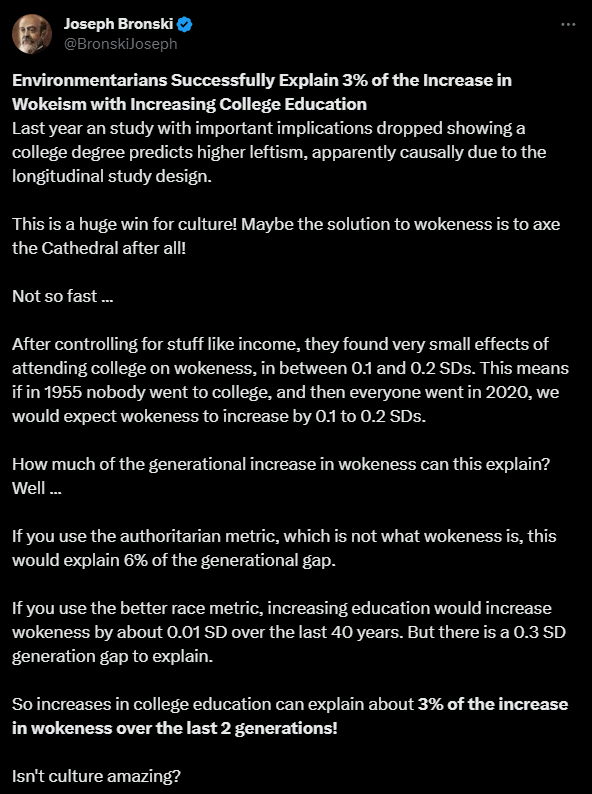
G represents gene score, the sum of the average effects of alleles on phenotype. We can do the same with M — somehow, people inherit an independent set of infolleles. Moldbug actually says they come mostly from university, which allows us to test his theory:
This is an intuitively silly theory for a number of reasons. For one, there is nothing true about leftism. Therefore, leftists would have to lie. But why would leftists lie? Because they made a mistake? Then why are they so rabid when their mistake is corrected? If someone accidently theorizes that race is not real, and then that theory is corrected, they should change their position, if they’re, you know, genetically the same as the people who enslaved blacks and waged war for Aryan lebensraum. Yet the leftist, who may appear to be mind-infected, is actually resistant to the well-known, decades old cure, which is HBD in the race domain. This is like there being an illness which causes a symptom. On the one hand, it can be of genetic origin. On the other, bacterial origin. We have anti-biotics. They don’t work on a patient. Moldbug concludes nonetheless, based off of nothing, that the genetic version of the disease does not exist and everyone merely has a bacterial infection, which will surely respond to the antibiotic that is his blog.
But we can go beyond mere intuition. There is a way to test the relative strength of genetic vs. memetic causation. It’s simply estimating the heritability and memetability of leftism. These are basically how much offspring phenotype causally correlates with the phenotypic sources of their alleles and infolleles respectively.
This is easy to demonstrate in the case of heritability. Consider the following: