IQ started as a measure of mental age. For some reason, this fell out of practice. I see two potential causes for this: first, political correctness. It’s rude to point out that the average black man has a white mental age of 12. Second, what is the mental age of a person with an IQ of 145? Since the brain finishes developing in between 14 and 16, and IQ starts decreasing with aging, it doesn’t make much sense to give the average person a mental age of 16 and a highly intelligent person a mental age of, say, 35.
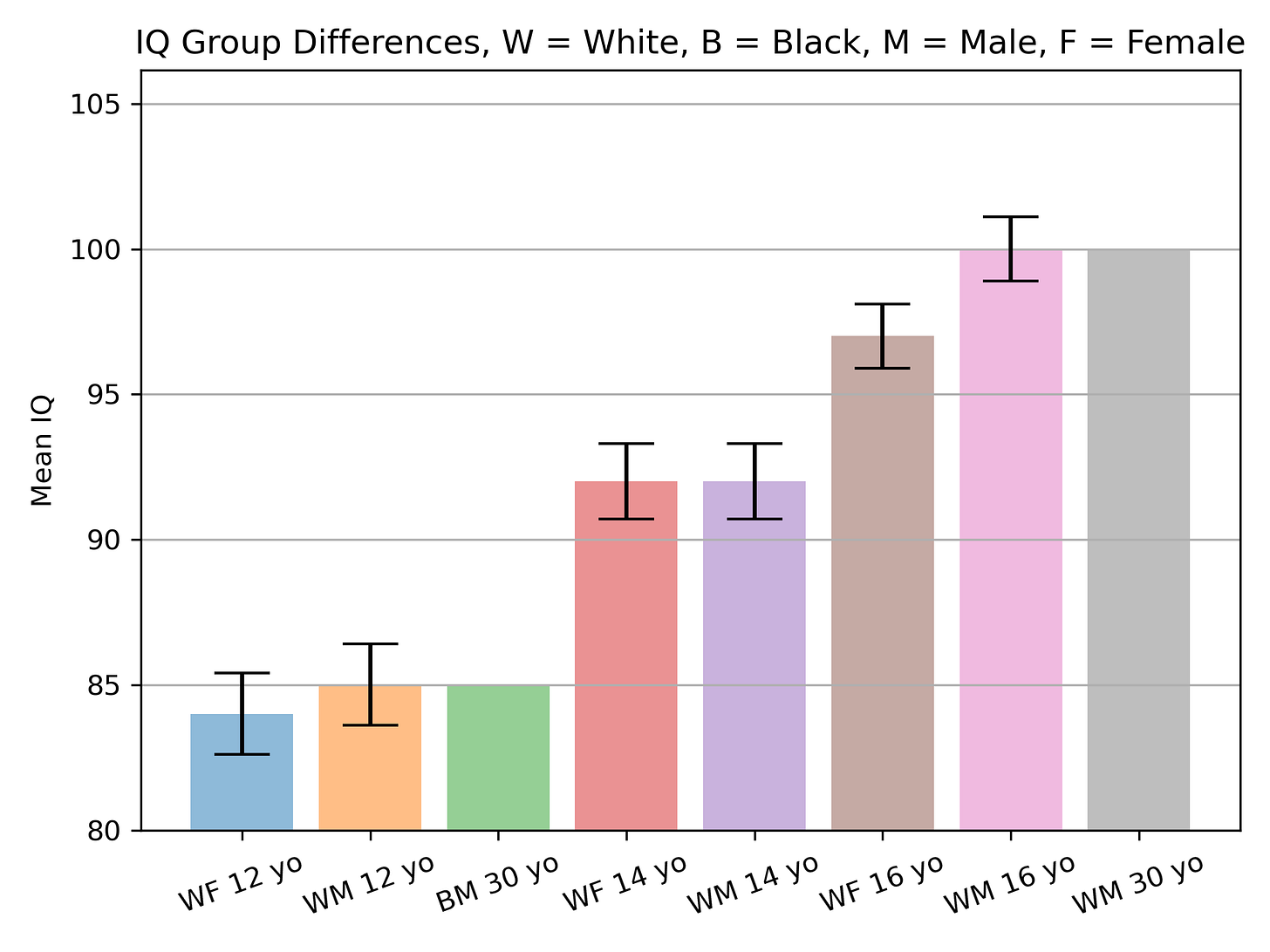
That said, IQ as mental age still makes sense in some situations. Recently, some educational tracking discourse has been circulating around X.
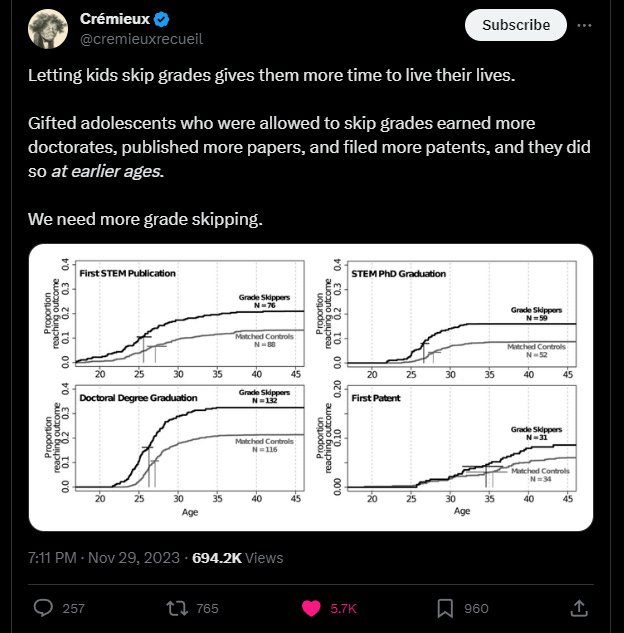
This raises a question: how inefficient is the current egalitarian education system? How many grades could kids be skipping? This question is answerable with a few simple assumptions.
First, we assume ideal grade level is purely a function of IQ. Second, we assume a grade’s IQ level is the same as the average student currently in it. Third, we assume all kids develop their IQ at the same rate, with their starting points offset according to their deviation from the mean as adults (this is unrealistic but probably doesn’t introduce much error into the analysis).
Now, given these assumptions, we can figure out what grade a 145 IQ 4th grader should be in.
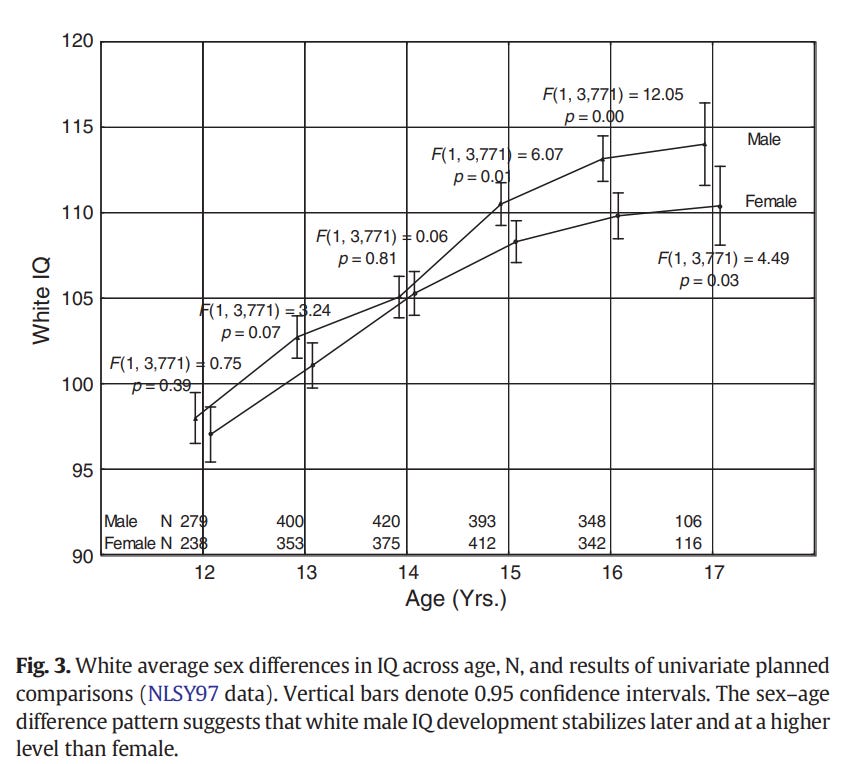
We can see here that from 12 to 15, average adult IQ goes from about 98 to about 110. In other words, it increases by 4 points per year.
If we extrapolate this slope, we can assume that the average 4th grade IQ is 8 points under the average 6th grade IQ. A 145 IQ 4th grader would be 45 points above the average. 45/4 is 11.25, so under this analysis the 4th grader could be in an arbitrarily high grade. Also, if we adjust the 15 year old mean to be 100, the mean 4th grader would have an IQ of 80. Thus, a 3SD 4th grader would have an adult IQ of 125, which is intelligent enough to do post-college work.
Just a 1 SD 4th grader, a member of the top 15%, is predicted to be able to skip 15/4 = 3.75 grades. This is roughly 8th grade level work in 4th grade. By extension, such students could begin high-school level work at the age of 11, and college-level work by the age of 15.
I have argued in my 1st book that only the top 15% or so of intellect need to attend college. This was inferred from labor statistics; only about 15% of jobs truly need a university education. By arguing that high school is redundant and worthless, I advocated that they simply skip it and begin freshman year of university at the age of 15. The analysis in this article is a nice corroboration of that idea.
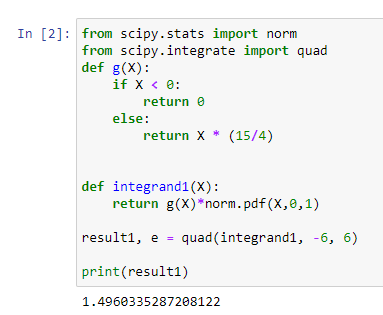
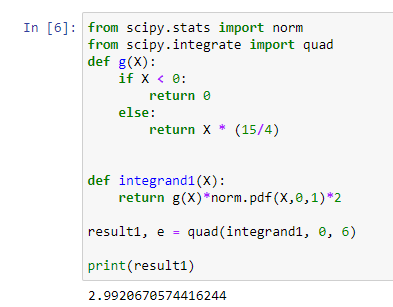
This analysis also shows how extremely wasteful the current education system is. In fact, we can compute the average number of years wasted given the analysis in this article. If we just take the number of grades you can skip given your IQ and let that be how early you could have graduated school, then your years wasted is equal to the number of grades you could have skipped. So we just compute the average number of grades that could be skipped, assuming all below average people can skip 0 grades. This can be written as follows:
\mathbb{E}[g(X)] \: \: \: s.t. \: \: \: X \sim N(0,1), \: \: \: g(X) = max(0, \frac{15X}{4})From this I got a waste of 1.5 years per person.
Comments
No comments yet.
Log in to leave a comment.