Decades ago, it was common for people to claim that evolution did not effect modern humans. Selection pressures were so small that they only produce significant phenotypic effects over thousands of years. In the 2000s and 2010s, the median view seemed to progress to to one where evolutionary pressures could produce differences over several hundred, or maybe a few thousand, years. Genetic changes could explain differences between Rome and the British empire, but not between 1920s American and 2020s America.
This view is still inaccurate. The fact is that selection pressures are often significant enough to produce social changes over 3 or 4 generations, sometimes less. Here, we will show this by computing contemporary selection pressures on different social relevant traits. We will conclude that pressures are significant enough to produce observable changes from as recently as the 1950s. Therefore, when explaining political changes since that time, it is crucial to not ignore evolutionary pressures and genetic change.
Selection pressures on intelligence
A 2018 meta-analysis found that the correlation between IQ and fertility is -0.11. Using the formula from the last article in this series with a fertility SD of 1.35 and a fertility mean of 2.35, as well as an h^2 of 0.66, we get a selection pressure on IQ of 0.6 points per generation. That means after 100 to 120 years (about 5 generations), the mean IQ will drop 3 points due to selection pressure.
This reduces the amount of people over 130 IQ per capita to 60% of what it is today. In other words, if this pressure were like this since the 1920s, and there were 3 million 130+ IQ people back then, there would only be 1.8 million such people today, assuming no population growth. If, say, 130+ IQ people (by 1920 measures) were the sole producers of innovation, the innovation would be almost cut in half.
Something like this model is approximately true. It’s called Smart Fraction Theory, and in essence the amount of people over 125 IQ (by 2020 Western standards) is what predicts key national economic variables.
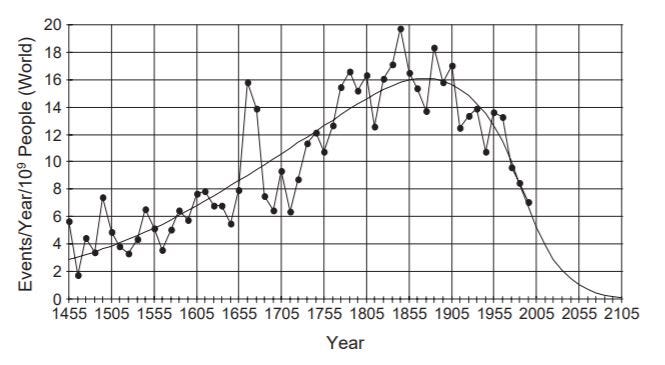
At the same time, innovation has been declining and nobody is sure why. Even HBD writers hypothesize about the rise of “conformity.” But the fact is that if the -0.6 IQ point selection pressure has been around for 5 generations, it would predict us falling to 60% of the innovation per capita of 100 to 120 years ago.
This is a large impact in one lifetime based on a very weak correlation and selection pressure. Henry Kissinger is still alive and was born in 1923; this entire decline has occurred in his lifetime based on a very small fertility gradient. This demonstrates how easy it is for even small evolutionary pressures to cause large social changes on small time scales. When hypothesizing about a recent social change, one must always keep in mind that unknown evolutionary pressures are probably contributing to the change.
Selection pressures on leftism
There was no study on this in the literature that used a continuous measure for leftism, so I did one.
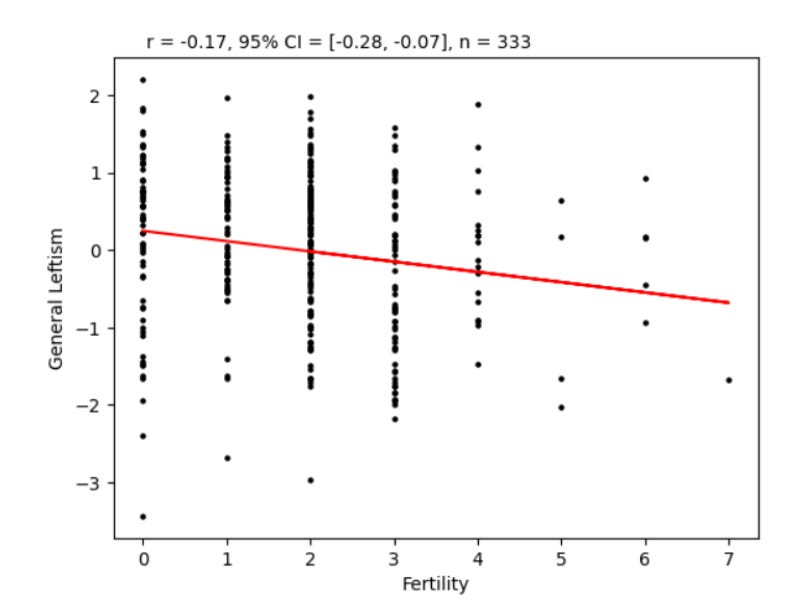
I found a -0.076 SD pressure on general leftism, meaning conservatives reproduce a little bit more. This is very similar to IQ’s -0.04 SD selection pressure.
This is somewhat strange as liberalism-conservatism seems resistant to environmental effects yet it has been changing in the opposite direction. A competing evolutionary pressure, like mutational pressure, may be to blame.
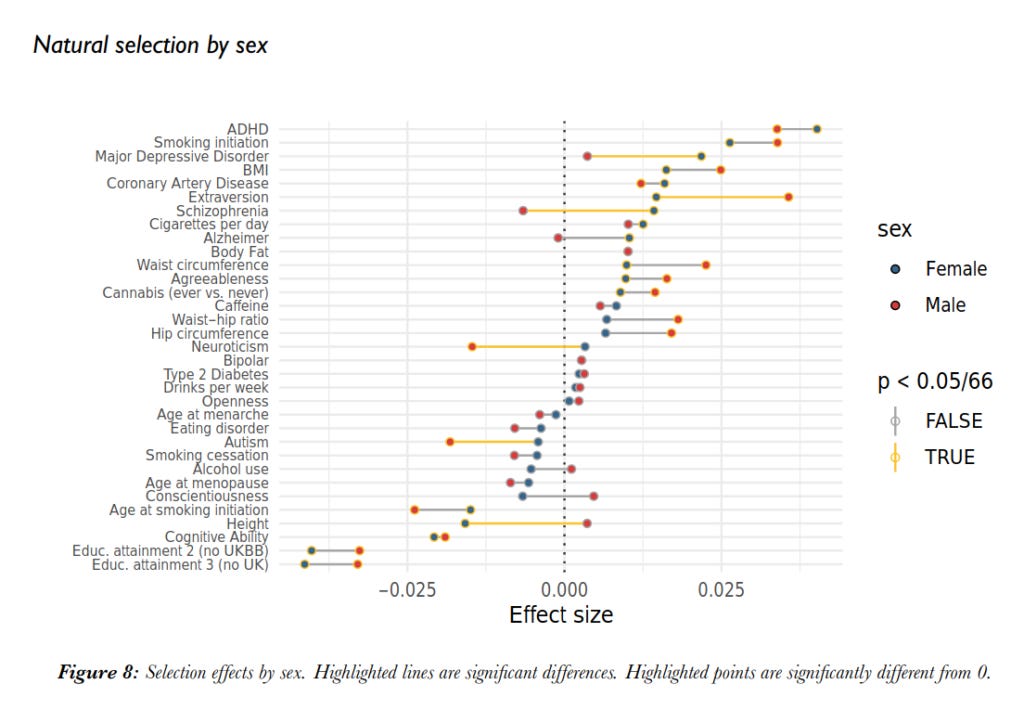
Other selection pressures
Comments
No comments yet.
Log in to leave a comment.