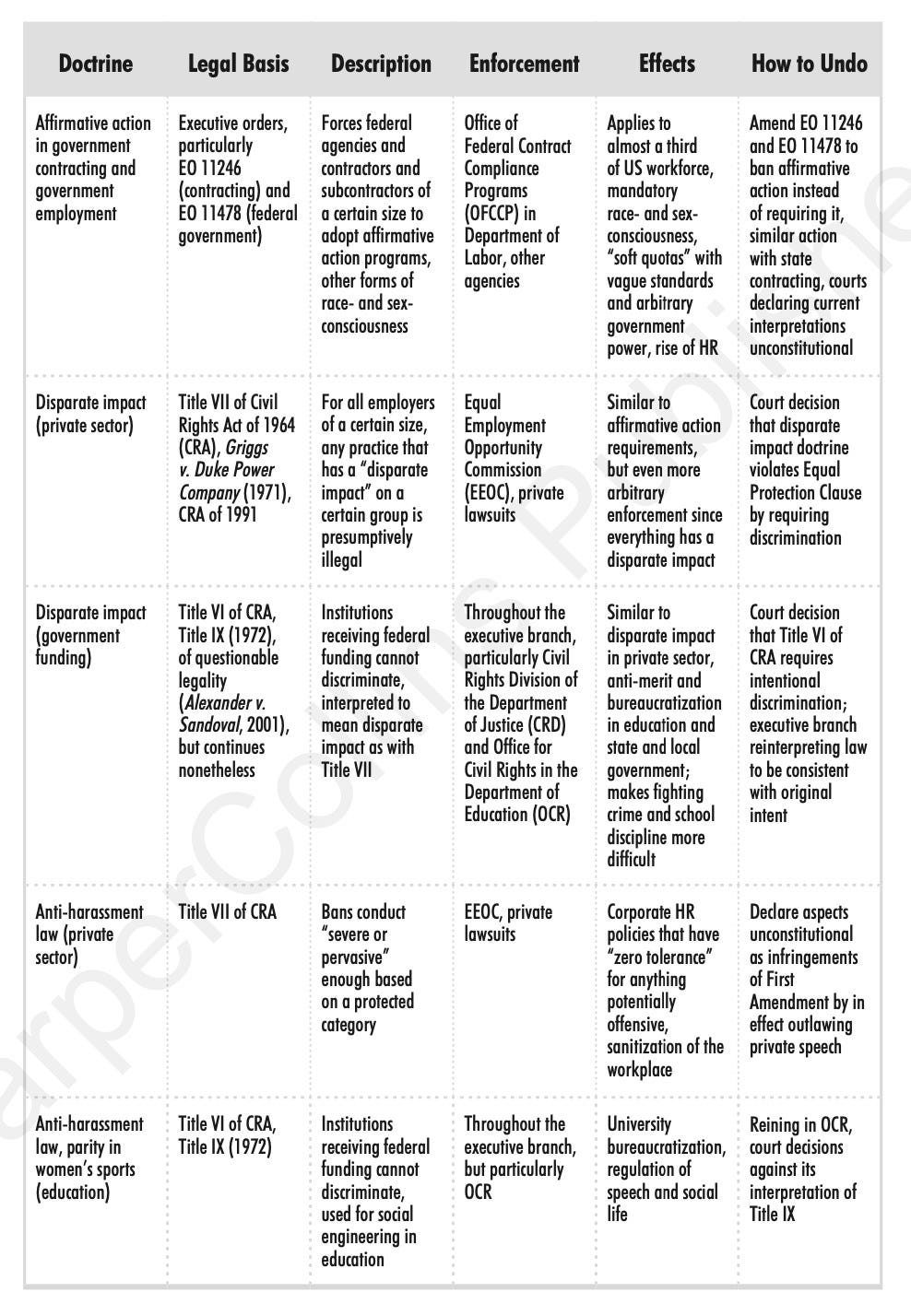
The rest of the book is essentially an elaboration on this summary table. He explains the history of each doctrine, and how they can be reversed legally. This part of the book, unlike the case for the origins of wokeness, is highly detailed and precise. Perhaps removing the first chapter and renaming the book to The Legal Basis of Wokeness would have been a more honest approach, considering the lacking quality and quantity of case for the origins of woke. However, it is likely that this would not have sold as well, and, to be charitable, selling more copies is likely to increase the probability that the book’s aim, the destruction of civil rights law, comes to fruition.
Conclusion
Hanania’s history of civil rights law is coherent and thorough, but his explanation of the origins of wokeness is lacking in logic and specificity. No single feature of the book makes this clearer than Hanania’s use of the word culture, a word which is constantly problematic for those who are trying to attain a truly scientific view of the origins of wokeness, and politics in general. Richard says,
Culture and Politics are Not Separate.
Culture vs. Politics is a false dichotomy.
Breitbart said “politics is downstream of culture.”
What is culture? The closest thing we get to a definition is this:
The state is so intertwined with the rest of life that it makes little sense to treat culture and politics as separate forces in a modern society.
Apparently culture is “the rest of life”. I applaud the attempt at a definition, because we usually don’t even get that. However, “culture” is obviously a vague concept not built for science. I have two suggestions for fixing this problem that I think are better. The first is to define culture as the average of behavior, or in other words, phenotype. This means C = E[P] = E[G] + E[Env]. Then you can see the State will be made up of people who probably are close, on average, to the overall culture. But sometimes there may be selection effects, and these can be researched. If there are selection effects, the State may tend to try to make the populace more like itself through modifying the environment and eugenics (historically, killing and imprisoning people it doesn’t like). Finally, a cultural change may be due to an environmental change or a genetic change.
The second suggestion is to just get rid of the word culture from serious thought. The first suggestion often amounts to forcing a specific definition onto the word, which captures some of the vagueness of the current concept but leaves out other parts. One issue is that culture often is defined to be different things. Sometimes it’s “the rest of life.” Sometimes it’s the set of all knowledge that can be transmitted to others. Sometimes it denotes the set of artistic works. It may be more clear to just taboo the word and use more specific labels for these disparate ideas, such as “mass behavior”, “the infosome”, and “artistic output”. Now it’s clear that the infosome might affect mass behavior and artistic output, whereas before you might say culture affects culture and culture, which is often something people almost do.
Without the murky concept of “culture” to drag it down, Hanania might have written a better explanation for the true origins of wokeness. “Culture” often obscures the biological basis of social reality – if Hanania could not have so easily said “culture”, he might have had to think more deeply about the ultimate causes of social phenomena such as political shifts. This could have led to the realization that the State is a sample of the population at large, and it is the behavior of the population at large that is changing, the State changing with it. The ultimate cause must be something broader than “politics” and more specific than “culture”, such as “mutational load.” But Hanania did not do this, and so he did not really reveal the true origins of woke.