The core “argument,” if it can be called that, of part II of Adam Rutherford’s How to Argue with a Racist, is that race is not real because everyone is related.
The core “argument,” if it can be called that, of part II of Adam Rutherford’s How to Argue with a Racist, is that race is not real because everyone is related.
Ancestral belonging and genealogy are things that fascinate us all, but racists especially: genealogy is possibly the second most popular pastime in the UK (after gardening), and the first in the US. Many of the arguments put forward by racists centre around belonging to specific demographics, the othering of different groups and the displacement of people. Many nonracists are also concerned with immigration in the modern era, but few express the sense of a people being replaced or a culture somehow being weakened. It is never clear what is being threatened when, for example, white supremacists express fear of the demise of Western culture. I don’t know what Western culture is, because it’s very clear to me that my culture is not the same as the culture of other people in my street, postcode, city, country or continent.
Go back a few centuries further and we reach a mathematical certainty referred to as the genetic isopoint. This is the time in history when the entire population is the ancestor of the entire contemporary population today. For the people of Europe, the isopoint occurs in the tenth century. In other words, if you were alive in the tenth century in Europe, and you have European descendants alive today, then you are the ancestor of all Europeans alive today (we estimate that up to 80 per cent of the population of tenth-century Europe has living descendants). Another way to think of it is like this: one branch of a family tree of two first cousins crosses in a shared grandparent; one branch of all European family trees cross through one individual in 1400 CE; at the isopoint, all branches of all family trees cross through all people for that population.
I am well aware, having said these facts to students and public audiences hundreds of times, that this is a brain-scrambling concept, because it is so far from our casual assumptions and thoughts about ancestry, family trees and identity. It certainly doesn’t sound right, and is further confounded as a concept by the calculations of the global isopoint – the year in which the population of the Earth were the ancestors of everyone living today. This, astonishingly, comes out at around 3,400 years ago. Everyone alive today is descended from all of the global population in the fourteenth century BCE.
As is apparent above, Rutherford isn’t arguing as much as he’s just misrepresenting the evidence and babbling about its extreme complexity, just like in part one. By my count, the string “complex” appears about 20 times in part II alone.
His only important claim in this chapter is his claim that everyone alive today is descended from the entire population of 1400 BC. This claim does not appear to be true. Rutherford doesn’t cite his sources, so it’s hard to fact-check. But a 2003 simulation with a liberal model where at least one mixture event occurred between groups in every generation estimated that the genetic isopoint would be 5,000 years ago. Still, it hardly matters whether the genetic isopoint was 5,000 or 15,000 years ago — Rutherford is obscuring that a living person’s degree of relatedness with any given individual alive at the genetic isopoint varies extremely.
Douglas L.T. Rohde, an original founder of the concept of the All Common Ancestors (ACA or genetic isopoint) point, who, unlike Rutherford, is not an activist and can understand college level statistics without breaking down and calling too “complex, dynamic, and vastly interweaved”, explains:
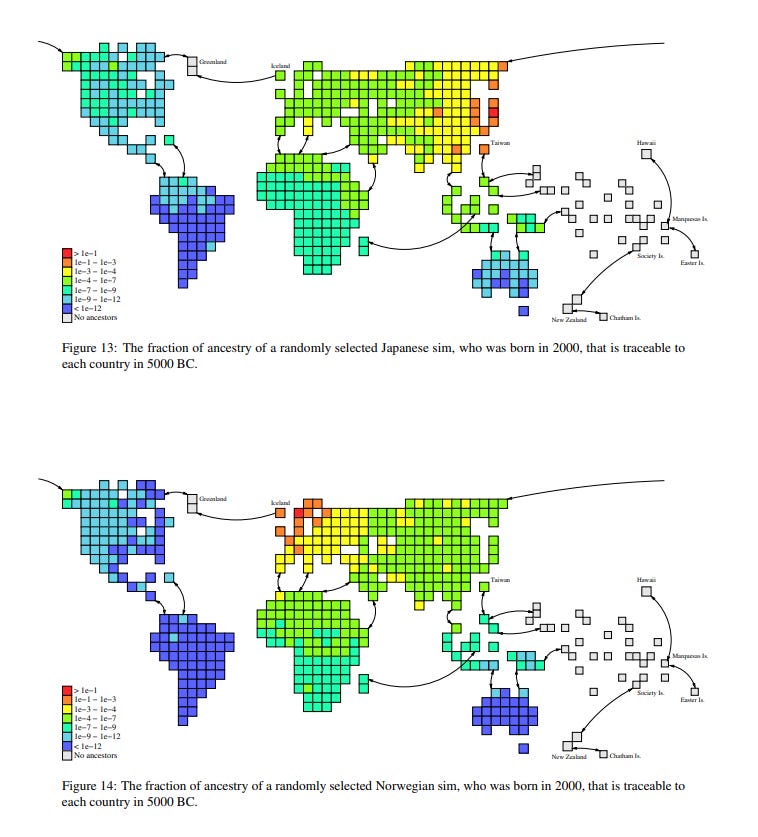
It is likely that the notion of a relatively recent ACA point may lead to some confusion. If we consider only ancestors who lived prior to the ACA point, a Japanese and a Norwegian today share the exact same set of ancestors. At first glance this seems patently ridiculous. Certainly the Japanese and Norwegian have quite different genotypes due to very different ancestry. The confusing fact is that both of these statements are true. Although the Japanese and Norwegian have the same set of ancient ancestors, they did not receive an equal hereditary contribution from each of those ancestors. The Japanese owes a small proportion of his genetic makeup to people living in northern Europe several thousand years ago, and a large proportion to people living in and around Japan, while the opposite is true of the Norwegian. Thus, their ancestry does differ considerably … We will first trace the ancestry of a randomly selected Japanese sim born in the year 2000 in one of the C2 trials. By 1500 AD, the sim owes 98.8% of his ancestry to his home country, the middle of the three Japanese territories, and much of the rest to the other two countries that form Japan. The remaining 0.4% is traceable to neighboring areas of China and Korea. By 500 AD, 98.9% of the sim’s ancestry is still attributable to Japan as a whole. This declines to 97.5% by 2000 BC, 95.7% by 5000 BC, and 88.4% by 20000 BC. The proportion of the sim’s ancestry attributable to each country in the world in 5000 BC is shown in Figure 13. The red and orange regions together account for 97.35% of the ancestry, with 2.62% from the rest of Eurasia, 0.014% from Africa, 0.00090% from Indonesia and Australia, and 0.00086% from the Americas.
Figure 14 shows the corresponding ancestry for a randomly selected Norwegian. In this case, 92.3% of the ancestry in the year 5000 BC is attributable to the country in which the sim lives, in central Norway, and 96% to Scandinavia as a whole. The Norwegian has about three times as much African ancestry as the Japanese sim, but much less American, Indonesian, and Australian. The Norwegian owes 0.00044% of his ancestry to 5000 BC Japan, while the Japanese owes 0.00049%, or about 1 part in 200,000, to ancient Norway. That would suggest that, at this rate of mixing, a typical Norwegian might be expected to have inherited about one haplotype block from 5000 BC Japan (Gabriel et al., 2002).